Vietnamese Peridot from the Central Highlands
Vietnam’s peridot comes from the Central Highlands — the volcanic plateau around Pleiku, Buon Ma Thuot and Da Lat — and not from Luc Yen at all. It is a yellowish green to olive green stone, it is essentially never treated, it arrives mostly in small sizes, and it is the least expensive natural gemstone we sell. It is also the one stone in our catalogue where we will tell you, flatly, that the origin on the invoice should not change what you pay.
That last point deserves the whole article. We spend most of our writing explaining why origin matters — why a Mogok ruby outprices an equally beautiful Luc Yen one, why cobalt spinel is a Luc Yen story. Peridot is the exception that proves we mean it when we say judge the stone rather than the passport.
Where Vietnamese peridot actually comes from
Three provinces in the Central Highlands produce gem-quality peridot: Gia Lai, Dak Nong and Lam Dong. The active workings are in Gia Lai — the Ham Rong and Bien Ho deposits near Pleiku, both of them extinct volcanic centres. GIA’s field study of the region puts their output at more than 100 kg of peridot-bearing material a month, of which 15–20% is of gem quality.
That is a genuinely productive deposit, and it is why peridot is one of the few Vietnamese stones a buyer can expect to find in quantity rather than one at a time. It is also several hundred kilometres from Luc Yen, which is worth saying plainly: peridot is a Vietnamese stone, not a Luc Yen stone. It reaches the northern markets because dealers move it there, the same way Luc Yen spinel reaches Bangkok.
A stone that came up from 60 kilometres down
Peridot is gem olivine, and olivine is not really a crustal mineral — it is what most of the Earth’s upper mantle is made of. Almost every peridot you will ever see is a fragment of the mantle that got a ride to the surface.
In the Central Highlands that ride was Cenozoic volcanism. Alkali basalt magma rising through the mantle tore off chunks of the rock it was passing through and carried them up embedded in the lava — ultramafic nodules 5 to 40 cm across, sitting in dark grey basalt like plums in a cake. Break one open and the green crystals inside are peridot. GIA’s work on the Vietnamese material dates the eruptive centres that delivered them — Pleiku at under 6.3 to 2.1 million years ago, Buon Ma Thuot on a similar clock, Da Lat older at 13.3 to 7.9 million — and calculates the conditions the crystals formed in: 910 to 980 °C at around 60 km depth, in a mantle rock called spinel lherzolite.
We think this is the best story in Vietnamese gemmology and nobody tells it. A ruby is a beautiful accident of continental collision. A peridot is a piece of the mantle in your hand.
What it looks like — and the honest limits
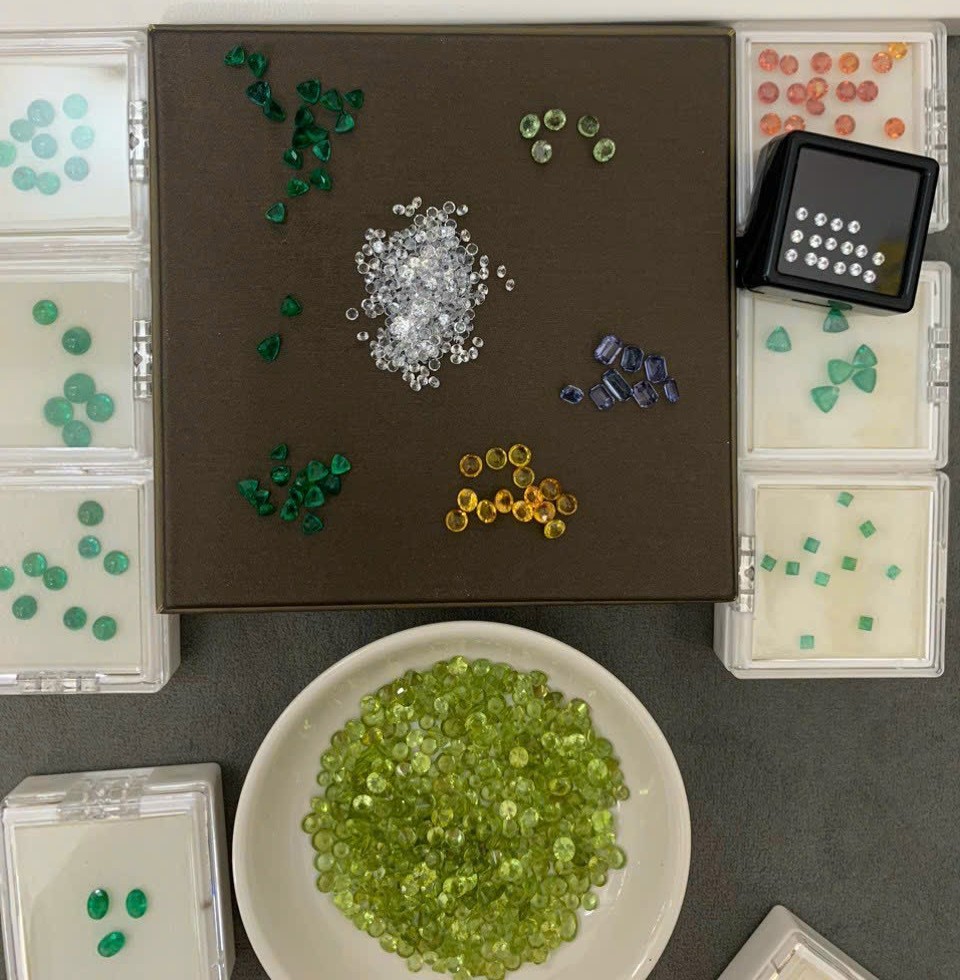
Vietnamese peridot runs from light yellowish green through to darker, richer yellow green, olive green and brownish green. Cut stones are typically an attractive yellowish green. The colour is not a trace-element accident the way ruby’s red is: peridot is idiochromatic, meaning the iron that colours it is part of the mineral itself. That is why peridot only ever comes in one family of colours, and why nobody has ever found a blue one.
The chemistry of the Vietnamese material sits squarely in the normal mantle range — forsterite content of 90.6 to 91.3 mol%, iron oxide between 8.24 and 9.90 wt%, which GIA notes is similar to peridot from Myanmar, San Carlos in Arizona, and Sardinia, and higher in iron than material from Tanzania or Zabargad. In practice, more iron means a slightly warmer, more olive green rather than the cool grass green of the very finest stones.
Now the limit, because it is the thing a buyer needs to hear. Vietnamese peridot rough is mostly small. GIA recorded most pieces at a few millimetres to about 1.5 cm across, with 4–6 cm pieces turning up only occasionally. Faceted stones in their study sample ran between roughly 0.75 and 1.41 ct. So if what you want is a clean twenty-carat peridot, Vietnam is not where that comes from — Myanmar’s Pyaung-Gaung deposit near Mogok and Pakistan’s Sapat workings are the sources for big fine stones, and we would say so rather than sell you a story.
What Vietnam does well is the everyday size band: clean, bright, honestly priced stones from melee up to a few carats, in quantity, month after month.
The part where origin stops mattering
Here is the fact that shapes how peridot should be bought. GIA’s own position is that fine peridot comes from many localities and country of origin is not a primary quality differentiator — the one exception being stones confirmed from Zabargad, the Red Sea island the Egyptians mined for millennia, which can carry a slight premium for historical value rather than for being better.
Compare that with ruby, where a Mogok report can move the price by a multiple, or with cobalt spinel, where “Luc Yen” is most of the value proposition. For peridot, the report tells you the stone is natural peridot; what you are actually paying for is colour, clarity, cut and size.
| Source | Geology | What it is known for |
|---|---|---|
| Myanmar (Pyaung-Gaung, Mogok) | Mantle-derived | Large, richly coloured stones; the classic source for big fine peridot |
| Pakistan (Sapat, Kohistan) | Serpentinised dunite — a different setting from the basalt sources | Exceptional clarity and large sizes; discovered in the 1990s |
| Vietnam (Gia Lai, Dak Nong, Lam Dong) | Xenoliths in alkali basalt | Steady production, attractive yellowish green, small to medium sizes, keen prices |
| USA (San Carlos, Arizona) | Xenoliths in basalt | Very high volume in small sizes; the everyday peridot of the American market |
| Egypt (Zabargad) | Peridotite massif | The historic source, mined for thousands of years; commercially exhausted, so confirmed stones carry a collector premium |
Note what that table does not contain: a ranking. Between Vietnam, Arizona and the everyday output of the other sources, you should buy the better-looking stone, not the better-known country.
Looking for a stone like this?
Tell us what you are after and we will reply within 24 hours with real photos from the market.
Treatment: the short chapter
Peridot is essentially never treated. There is no commercial heating process that improves it, no diffusion, no standard practice of any kind — what comes out of the basalt is what ends up in the ring. Occasionally a badly fractured stone will be clarity-enhanced with a filler, which should be disclosed like any other treatment, but it is uncommon and it is not what you will meet at the ordinary end of the market.
This puts peridot in the same happy category as spinel and in a different world from corundum, where heat is the default and the disclosure line on a report is the single biggest lever on price. If you want that comparison in full, we wrote it up in heated versus unheated ruby and sapphire.
How to tell it is real
Peridot is easy to identify and hard to imitate convincingly, which is a pleasant change.
- Doubling. Peridot has unusually strong birefringence — 0.036 in the Vietnamese material. Look down through the table with a loupe and the facet edges on the far side of the stone appear doubled, as if printed slightly out of register. Green glass and cubic zirconia do not do this. It is the single most useful check in the field.
- Lily pads. The classic peridot inclusion: a round, flat healing plane with a small black crystal at its centre — usually chromite, sitting in a tension halo. GIA found these throughout the Vietnamese samples, along with partially healed fractures showing iridescence.
- The colour itself. That specific yellowish, slightly oily green is hard to fake and hard to mistake once you have seen a few.
- Warmth and weight. Glass warms in the hand quickly and feels light. Peridot has a specific gravity around 3.3 to 3.5 and stays cool a moment longer.
Wearing it: the one real drawback
Peridot is 6.5 to 7 on the Mohs scale. That is well below ruby and sapphire at 9, and below spinel at 8. It is also more sensitive than most gems to acids and to sudden temperature change. Practical consequences:
- Set it where it will not take knocks. Pendants, earrings and protected settings suit peridot far better than an exposed, high-profile solitaire on a hand that does real work.
- No ultrasonic cleaner and no steam. Warm soapy water and a soft brush, and nothing else. Thermal shock can fracture a peridot outright.
- Keep it away from acids — including household cleaners, and including the pickling solution on a jeweller’s bench. Tell your jeweller what the stone is before any repair work near heat.
- Store it separately. A harder stone in the same pouch will scratch it.
None of this makes peridot a bad buy. It makes it a stone to set thoughtfully, which is a different thing — and at peridot prices, setting it well is affordable.

Buying Vietnamese peridot: what to look at
- Colour first, and judge it in daylight. Saturated green with as little brown as possible is what you are paying for. Warm indoor light flatters peridot; daylight tells the truth.
- Decide whether you want size or colour. At Vietnamese sizes you can have a clean bright stone easily. Chasing both size and top colour will push you toward other origins and a different budget.
- Look for the doubling and the lily pads — free evidence that you have a natural peridot rather than glass.
- Buy the parcel if you want value. Peridot trades as a lot. Picking through a parcel is normal and is where the good stones are.
- Do not pay an origin premium. If somebody quotes you a Vietnamese peridot above the market because of where it is from, they have the economics of this stone backwards.
- Ask about the setting before you buy. Hardness 6.5 to 7 is a design constraint, not an afterthought.
What it costs
Peridot is the least expensive stone in our catalogue, and there is no reason to be coy about the numbers. Independent 2026 price surveys put commercial-grade peridot — the yellowish, olive end — at roughly $20 to $40 per carat in the one-to-two-carat range, with fine, vivid, eye-clean material at $40 to $90. Above that sits a separate market: top-colour stones of five carats and more, which is Myanmar and Pakistan territory and runs from a few hundred dollars a carat upward.
Vietnamese retail sits inside that framework rather than below it. Surveying loose, certified, faceted peridot openly listed by Vietnamese sellers in September 2026, clean one-to-three-carat stones run from about 750,000 VND per carat at the value end to about 2.2 million VND per carat at the luxury end — roughly $29 to $84. The upper figures generally come with larger stones and a seller’s own top clarity grade attached; the lower figures do not automatically mean lesser stones. Which is the practical lesson: at these prices the spread between sellers is wider than the spread between stones, so compare goods rather than labels.
Two quirks are worth knowing before you negotiate. First, Vietnamese sellers overwhelmingly price peridot at a flat rate per carat regardless of size — we found the same per-carat figure applied to a one-carat stone and a five-carat one. International pricing does the opposite: per-carat rates roughly triple between one carat and ten, because clean large stones are genuinely scarce. If you want a big peridot, buying it in Vietnam is unusually good value. Second, prices quoted per stone rather than per carat tell you nothing at all — a number without a weight beside it is not a price.
Our guide to buying gemstones in Vietnam covers the checks and the paperwork, and the Luc Yen origin guide has the price picture for the northern stones — ruby, spinel and sapphire — which is a very different conversation.
Common questions
Is Vietnamese peridot good quality? Yes, for what it is. Its gemmological properties sit in the normal range for basalt-hosted peridot worldwide, its colour is attractive, and it is untreated. Its limit is size, not quality.
Is peridot the same as olivine? Peridot is the gem-quality variety of the mineral olivine. All peridot is olivine; most olivine is not gem quality.
Why is peridot so much cheaper than ruby or spinel? Supply. Peridot is abundant from many sources worldwide, it is softer, and it does not have the collector demand that has pushed spinel prices up. Cheap does not mean inferior — it means available.
Does peridot really come from meteorites? Some does. Pallasite meteorites contain gem olivine, and stones cut from them are sold as extraterrestrial peridot — a curiosity, priced as one. The peridot in ordinary jewellery came from Earth’s own mantle, which is remarkable enough.
Is peridot an August birthstone? Yes — August shares its birthstone with spinel, which is a pleasant coincidence for a Luc Yen dealer.
Will peridot fade? No. The colour is structural, not a dye or a treatment, and it is stable in normal wear and light.
Why we sell it
Peridot will never be the stone that makes this valley famous. It is not rare, it does not have a legend, and no auction record will ever hang on it. What it has is a straight story: no treatment to disclose, no origin premium to argue about, a real deposit still producing, and a price a person can pay without thinking hard.
It is also, for that reason, the stone we most often suggest to someone buying their first Vietnamese gem. You can see what we currently have on our peridot page, and if you like how it looks, that is the entire case for it — which, at the end of a long article about geology and iron content, is rather the point.
Looking for a stone like this?
Tell us what you are after and we will reply within 24 hours with real photos from the market.
Sources
- Huong et al. — Peridot from the Central Highlands of Vietnam: Properties, Origin, and Formation, Gems & Gemology, Fall 2016 (deposits, output, xenolith host, sizes, chemistry, inclusions, formation conditions)
- GIA — Is peridot from Myanmar, Pakistan or Egypt worth more? (origin and value; the Zabargad exception)
- GIA — Peridot Gemstone (properties, identification, care and cleaning)
- GIA — Gemological Characterization of Peridot from Pyaung-Gaung, Mogok, Myanmar, Gems & Gemology, Winter 2021
- Peridot Price Per Carat (2026) — quality and size price bands used in the costs section. Vietnamese retail figures are our own survey of publicly listed loose certified stones, September 2026.
I'm Phuong — it means phoenix in Vietnamese, so friends abroad call me Phoenix. I'm a second-generation trader: my family has bought and sold stones at the Luc Yen market since 1990, from the ruby-fever years to a remarkable cobalt spinel strike we sold at the mine in 2020. On YouTube I test stones on camera in Vietnamese for 48,000 subscribers; here I do the same in English. Photos unedited, treatments disclosed, origin named — because I'll be facing the same market women next Sunday, and reputations here are for life.